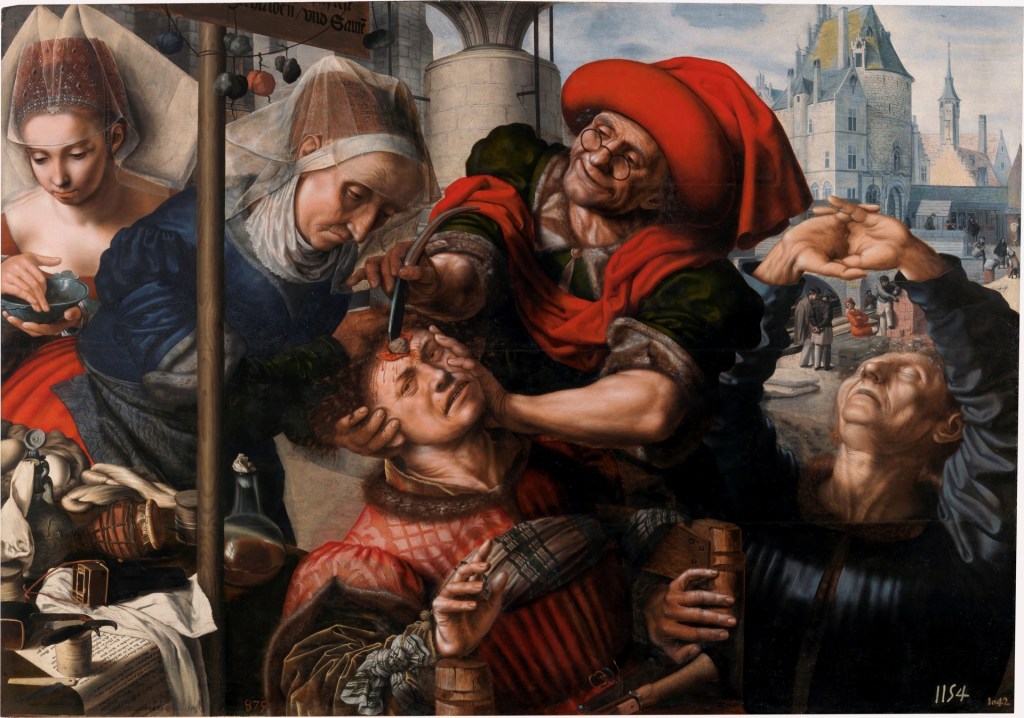
The Surgeon or The Extraction of The Stone of Madness is an oil painting that was completed between 1550 and 1555 by Flemish born artist Jan Sanders van Hemessen. What is immediately perceived when looking at this painting is the subtly glossed, unvarying quality of the oil paint rendered on the surface of the canvas. The application is considered, resulting in sharp, distinguishable yet undetectable detail. This high degree of realism reveals the scene portrayed as a documented reality. Its realism, attributed by lack of visible brush marks, proposes that the artist endeavoured to represent the subject matter truthfully; to appear that it was dealing with the dramatic scene forthwith. The dimensions of the work do not take precedence over the composition of its subjects. Spanning 141 cm across, with a height of 100 cm, the painting is by no means vast. Accepting its size, the art work is to be viewed with a certain adjacency. Like a window, an aperture exposing a present moment in time. The Surgeon or The Extraction of The Stone of Madness demands to be viewed and understood as a universal happening that exists outside of the mind.
Hemessen can be ascribed to multiple movements at this time of artistic ferment in the sixteenth century. He travelled from the Netherlands to study the works of the High Renaissance masters, marking the beginning of the Romanism period. Hemessen’s composition places five figures in the foreground. Only their upper bodies are depicted which locates the action in immediate proximity. In the distance, other people are visible, going about their daily business in this urban setting. Two women stand on the left of the frame occupied by their delegated tasks. The young woman, furthest to the left and set behind the older woman, dips her fingers unceremoniously into an ornate bowl. Her expression is unconcerned as she appears detached from the questionable occurrence playing out before her. Her exposed decolletage confirms her youth; her porcelain flesh the most illuminated. This indicates that the light source originates from the upper left hand side of the painting. Below her, a cluttered work table spills over with scientific instruments. Bottles, vessels, an unsoiled cloth and a handwritten document jostle for space in the chaos. From this table a wooden pole protrudes upward, separating the young woman from the others. It appears to advertise the services provided here. The calligraphy is interrupted by the limits of the painting, and so its message can not be deciphered. Six spherical bundles hang curiously from the signage, tied together with a piece of thin black string. They loom over the head of the older female figure whose occupied yet emotionally vacant gaze is directed towards the head she cradles with assertion. At the central point of the painting the young man’s face is quelled by the hands of the surgeon. His skin visibly tensed as his neck contorts and wrinkles in agony. His eyes ooze with terror and his direct gaze pleads for comfort. The surgeon inserts a handheld instrument into the forehead of the tearful young man. His concentrated gaze lurks wryly behind a pair of black pince nez. Wielding this cumbersome curved spatula, a moment of suspense is vividly depicted. The raw flesh peeling back with impeccable precision, like the opening of a book, will release a small grey stone to be read as the stone of madness. While the surgeon concentrates on coaxing out this mineral matter, the patient’s only focus can be excruciating pain.
This painting is a striking representation of neurosurgery in art at a time when new ideas about the world reflected new uncertainties caused by human failings such as greed, vanity and ignorance. Explicitly within the church, as its authority was debased for scandalous revelations exposed that the faithful could buy forgiveness from the pope.1 The predominant interpretation of The Surgeon or The Extraction of The Stone of Madness is a critique of the way in which this fraudulent doctor prays on the new found faith in science that these patients sought to act upon. The surgeon is an imposter whose only interest is money.2 Note that the attire of all five individuals depicted are a plentiful display of wealth. The men boast fur cuffs whilst the women in their jewelled veils allude to a decadent lifestyle. This time of religious turmoil was parallel to or perhaps preponderant to an epistemological shift. The scientific enlightenment not only displaced the authority of the Church but man’s credence suffered the unfortunate consequences of scepticism in this uncertainty.
A new pictorial language needed to be realised in a world that was undergoing riotous and radical change. Hemessen answered by combining the typical features of early Netherlandish genre painting with a sharp knife of satire, cutting through his use of symbolic iconography, dramatic gestures and humanistic themes. These visual strategies become interwoven with new found techniques learnt from the Renaissance Masters. His use of chiaroscuro deepens the tonal qualities throughout the painting’s composition; containing the very moment in the light of day. The stage is set for the ridicule intended to expose the truth to play out upon. Deep cerulean blues evoke feelings of peace and confidence, whilst pops of a toxic vermilion red exhorts danger. Hemessen communicates this satire by exaggerating idioms of emotionalism through the physiognomy of the characters. Each facial expression is incongruous to one another thus, the painting is crude to the senses. Its subjects are staggered with asperity, the jagged rhythm serrates the frame as the characters assemble into a W formation. At the focal point the surgeon’s supercilious smile can not be ignored, his eyes drooped and emotionless. He works with fortitude as the figure on the far right extends his interlocked hands up above his head, level with the surgeon’s shoulder. The man kneeling on the ground, beseeches the heavens. His eyes sealed and silent. Praying to God whilst he can, for he is next in line. It is in his expression that the true irony of the painting unravels. The Surgeon or The Extraction of The Stone of Madness is an allegory for stupidity and gullibility.3 The symbolic narrative finds the stone itself representative of an individual’s madness, which, once extracted, man will be free from mental ill health. Alternatively, the very act of attempting to remove a metaphorical stone is chaotic and extremely foolish. Either confirms the stupidity of man for no stone will be found in one’s skull. Alas, man can not fully believe in God, nor can he fully believe in the surgeon.
 CONNIE HOPE