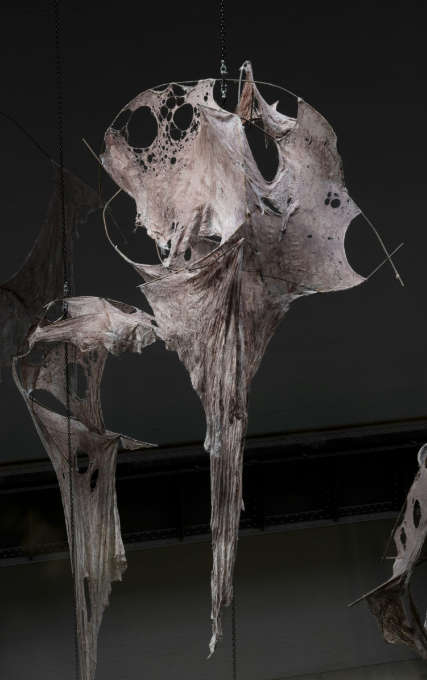
Mire Lee, Open Wound. Tate Modern 2024-2025.
Internal Matter // /ɪnˈtəːnl/ /ˈmatə/
Prologue // /ˈprəʊlɒɡ/
Glossary // /ˈɡlɒs(ə)ri/
Abstract // /əbˈstrakt/
Opening // /ˈəʊp(ə)nɪŋ/
Epidermis // /ˌɛpɪˈdəːmɪs/
Dermis // /ˈdɜː.mɪs/
Hypodermis // /ˌhī-pə-ˈdər-məs/
Closing // /ˈkləʊzɪŋ/
Illustrations // /ˌɪləˈstreɪʃns/
46. Bibliography // /ˌbɪblɪˈɒɡrəfi/
Prologue // /ˈprəʊlɒɡ/
Dermatitis Factitia
I sit to write. Two separate entities divert my devoted attention to this submission. These being skin and machines. Between each fleeting burst of tapping on the keyboard my finger tips believe there is something better to do. To pick, peel and pluck at the skin I sit within. The weight on the other side of my perfectly balanced scale of unproductivity is this venerable desktop. Which interrupts my flow in a similar manner. Yes, the one that seems to take pleasure in warning me that the browser is no longer supported and an update is required. The irony is that I know full well this fifteen year old lump of once extremely desirable californian-designed chinese-made hardwear will continue to be my scribe until the bitter end, even though its software says otherwise. Typing, (not to be conflated with writing) can be a frustrating mix of impatience and irritation. The former pertaining to my machines’ painfully slow reaction times and the latter the tangible distractions that I scavenge for upon my body. I can, however, look past the fact that the computer demands a constant feed from the mains supply, like a thirsty newborn creature sucking from the breast of its mother, because I need to keep it satisfied enough, or alive enough to translate the words that permeate my mind and escape though my fingertips. Alas, I stare at the scattering of dead skin that lies camouflaged on my dirty cream carpet beneath my feet at the desk where I write. Those dry fleshy offerings have become synonymous with my academic attempts. It seems I can only write a few sentences before I remove my hands from the keyboard to examine the lifeless skin on the undersides of my feet. I know I have to ignore the self made little islands of epithelial debris, but my body seems to be a waiting room in which the only thing I can do to pass the time is survey my skin. I’ve taken my ticket. Now I wait for my name to be called. The deadline I find myself intertwined with is looming ever closer and I do so desire freedom from the tyranny of arranging sentences in such a way that will make any sense at all to you, discerning reader. For this reason I yield to the superior dual force that perpetuates the delicate stasis of skin and machine. I’ll allow my writing to become not only earnest, but discreetly grotesque. Focusing on the localised relationship between flesh and machine seems like the most natural starting point. I must show my appreciation to my internal and external and these machines because without them, none of this writing would be possible.
Glossary // /ˈɡlɒs(ə)ri/
Machine | mə-ˈshēn
Robotic, lo-fi mechanisms that are non-human. But may appear to replicate certain human characteristics. But are not particularly anthropomorphic. Specifically, the newly built motorised turbine that is a key element in Mire Lee’s Open Wound, the main object of focus for this text.
Semantics | si-ˈman-tiks
The analysing and assigning of words to their meaning, and their relationship to other ways of communication, be it visual or visceral.
Skin | ˈskin
The skin is the first interaction between the body and the external world. A surface that simultaneously provides us with and protects us from interaction from the external. Thus, the skin serves as both boundary and vessel. Allowing some things in and others not, the skin can be defined as a semipermeable membrane. What lies within is perhaps just as vulnerable as it would be without its fleshy membrane.
Skins | ˈskin s
Mire Lee’s sculptural elements presented in the installation Open Wound.
Soma | ˈsō-mə
By definition, it is the body of an organism that exists as distinct from the mind.
For the purposes of this text I have taken a slight artistic licence with the semantic values ascribed to this word. Thus, soma pertains to the sensation of feeling. Somatic responses therefore are instinctive reactions to a stimulus or situation.
Skin as diagrammatic.
Skin as decoration.
Skin as dispersed.
Skin as disrepresented.
Skin as disorganised.
Skin as division.
Skin as drawing.
Skin as separator.
Skin as signifier.
Skin as space.
Skin as sensitivity.
Skin as soma.
Skin as semantic.
Abstract // /əbˈstrakt/
In this text I avail the three interdependent layers of skin, the dermis, epidermis and hypodermis, as individual lenses with which I look through to critically respond to Mire Lee’s monumental sculptural installation Open Wound. These three separate surfaces coalesce as one connected whole. Be that as it may, it is necessary to traverse each individual layer separately in order to understand Lee’s Open Wound as a body of work that functions as such.
Layer one, the dermis, consists of an analysis of appearance, the how of seeing at surface level and an ultimate submission to the visceral feelings that emerge from material focused, sustained looking. In Layer two, the epidermis, the connectivity of semantics and somatics is key in understanding Lee’s references in conjunction with connotations of labor and maintenance, particularly within her main reference point of the miners changing room. Finally, we reach layer three. In the hypodermis, I seek to unveil deeper meaning by considering Open Wound as it was intended; an industrial womb. Both in the wider context of contemporary sculptural practice and within current cultural climates as discussed by critics and thinkers.
Opening // /ˈəʊp(ə)nɪŋ/
It can be said that the skin is neither where the body starts nor ends. But without the skin, where would the body be, how could the body be? The skin is both restrictive and regulative, insofar as its semi-permeability grants access to some substances while defending against others. Our internal spaces are contained and whatever seeks entry, material or otherwise, is filtered through the skin via a selection process that science defines as dermal absorption; a microscopic transportation of chemicals from the outer surface of the skin, in which substances enter into the circulation of the body. In this way, whatever is outside of the body ignores the boundaries set by the skin. This non spatial division means that ‘skin only separates a living inside from a non-living outside.’ So, the skin exists as an in-between, a formed state of flux, a grey area with silver linings. ‘It may be, therefore, that skin is not part of the body but a condition of its intelligibility, a marker of the oppositional difference between inside and outside, body and world.’ This holistic acknowledgement of flesh leads me to the first non sensory organ, aka appendix that will aid this text.
Figure 1.
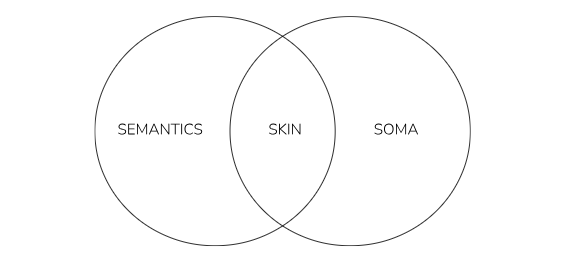
The venn acts as a textual speculum that pries into and diagrammes the space within which the skin becomes contained and constrained by how it is defined, and how it is expressed. Illustrating the interconnectivity of language and feeling. The skin is the fleshy membrane that relinquishes the internal into the external. It is for this reason that the skin becomes a simultaneous barrier whilst opening as a pathway. Perhaps the journey of the skin is how it is alive with sensation, a big red button for pleasure and pain. Communication through touch allows us to understand the way we react to external environments. And so the body becomes a fluid entity, (un)contained and (un)organised, held together by the skin. ‘The skin is often associated with wholeness and entirety. The skin after all, is not located at any one point in the body, like the other sense organs. Indeed, the skin provides the medium in which the other sense organs are located, and the element of which we feel they are largely made.’ I propose that the skin acts primarily as a vessel. A vessel that we all utilise. ‘Flesh has a different constellation of meanings than skin, some of them involving metaphors of liquidity, as if the body is a bag of skin holding a fluid interior. In general, the invisible inside of the body has been considered too painful to represent, and few artists have made pictures of the open body.’ Although there are distinct disparities between what is felt and what is thought, the mind and body’s enabling axis is the skin. Thus, when ‘pain pales, thought takes its place.’ Categorization of the skin’s functionality pertains to protection, production, excretion and sensation. These actions work in conjunction to regulate and maintain the inner body. What is felt somatically can be described semantically, yet the two ideas also exist as mutually exclusive. By this I mean to say that if semantics is concerned entirely with linguistic meaning, it is inevitable that misinterpretation will ensue. Especially when considering objects that produce objectively subjective responses, i.e works of art. It is common to maintain the qualities of misinterpretation through use of language, proper or improper, hence why so many arguments are lost on semantic grounds. However, the skin rarely miscommunicates. ‘If skin isn’t the place where all sensation is at its most precise, or – to invert the equation, in accord with the preeminence and priority of the body itself – if sensation doesn’t speak most eloquently using the language of skin. Perhaps the forms and possibilities of skin are the words and grammar of sensation, and everything else somatic (the viscera, the excreta, food still to be eaten, the disembodied self) is only a reflection, an abjection, or a falling echo, of that primary source.’ Alas, how can you be more succinct than a feeling? For using words may never fully articulate the nuance of visceral perception. The skin tells us what happens in the outside world, locally via its visuality and physicality. The skin is like parchment paper, each body a carbon copy scroll that duplicates and communicates the universally understood characters of somatic script. It is a language that will always be alive. ‘Skin may be the most sensitive and eloquent signifier of the body.’ I propose that semiology concerns itself with the body, insofar as the ways in which skin can be read. There is no skin without feeling, but it is not infrequent that there appears to be no words to describe a feeling. ‘The skin, as we see it, uses the outside world to help it express what needs to be said.’ This speechlessness of the skin does not necessitate its inability to communicate. Infact, the skin is able to disseminate its messages via all of the senses, since the skin covers all of the sensory organs whilst also being an organ itself. So, albeit a lack of linguistics, the skin has a unique language. It changes colour, its temperature fluctuates, marks appear and disappear. Pain is felt. Openings heal. Unless they demand to be left open. Perhaps this is why visual equivalents of the skin become disturbing images, verging on violent. This is certainly true of the intentions of artist Mire Lee in the installation commissioned by The Hyundai motor group. ‘Mire Lee’s sculptural installations are visceral, emotional and existential. By combining industrial materials such as steel, cement and silicone with machineries to create fantastical environments with kinetic elements, her work explores the tension between soft bodies and rigid systems.’ The skin, the way it, and the living being it covers responds to the external will always be varying. Varying sensitivities mean that particular ideas, feelings and responses are manifold. Put simply, this is subjectivity. ‘The biochemist sees it (skin) as an assembly of enzymes, the cytologist as an assembly of cell types, the anatomist as a formed structure.’ I’d like to consider the skin as a formed structure and the only viable vessel for somatic response to the external world. It is the point at which we encounter the world and that the world is able to encounter us. Consider the skins functionality as an entity constructed entirely of entry and exit points. ‘Although the actuality of the skin may have been invisible to the anatomist, or interesting only as impediment, a formal idea of the skin began to play an important structural role in maintaining the relations between the body and the world.’ The skin can not be defined as purely sensory for it is also the immediate ocular sense of self. It pertains to recognition, beauty, pleasure, pain. It is a window to individual identity. ‘It is interesting how far the optical metaphor takes us in a domain where there are no eyes: in skin, everything is immediate, bounded, instantaneous and sharp. Skin is like the thin plane of perfect focus in an optical system: everything beyond it (outside the body, in the world) and everything in front of it (in the body, in the more-or-less hidden insides) is blurred.’ Lee’s work has always considered the blurred boundary of inside and outside, and what deviation from these binary positions looks like. When overseeing the delicate and grotesque operation that is Mire Lee’s Open Wound, you are subjected to the precise choreography of emotion that is just as uncomfortable and tender as cut flesh.
 CONNIE HOPE